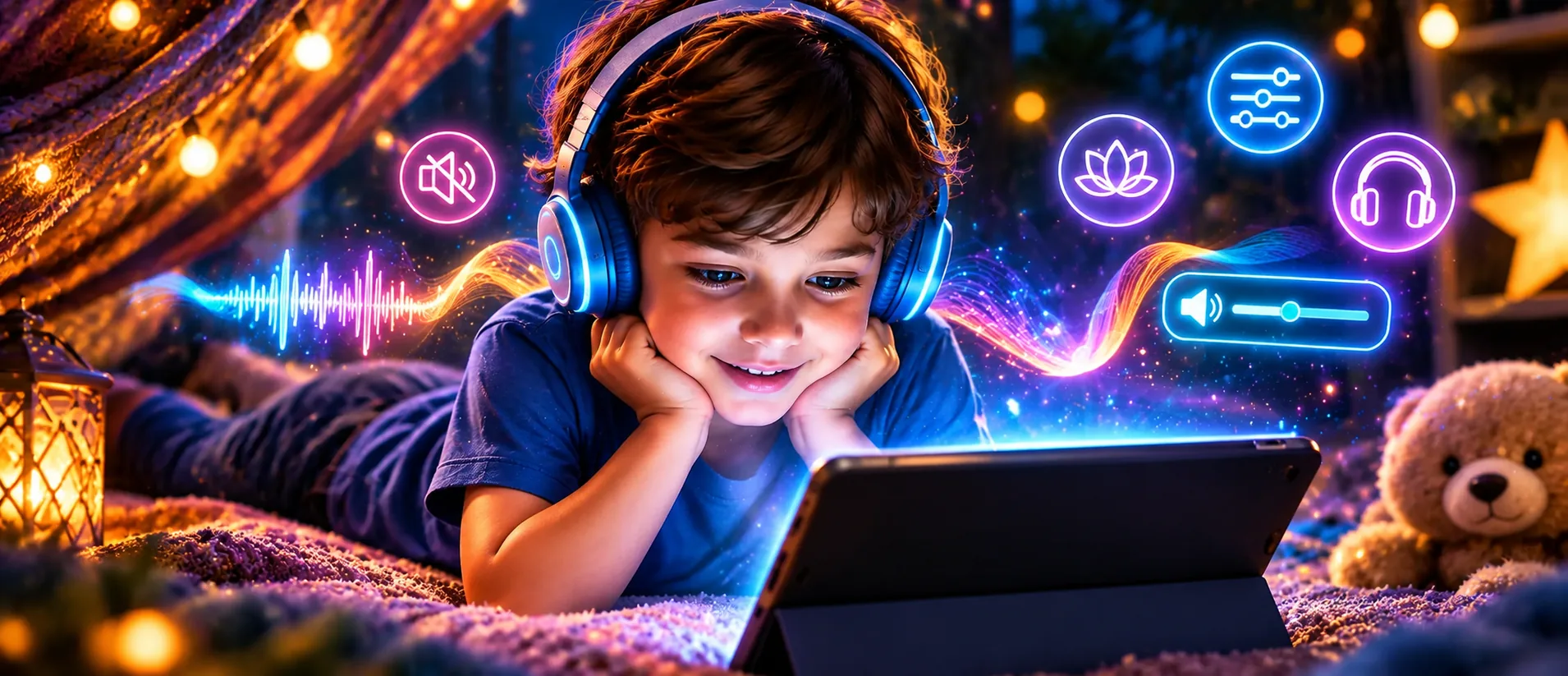
A sound that one person barely notices may feel intense or uncomfortable to someone else. A chair scraping, an appliance running, several conversations at once, or an unexpected sound effect in an app can change an otherwise simple experience.
For some autistic people, differences in how sounds are perceived and experienced are part of everyday life. Research is still working to understand this diversity, while also exploring a practical question: how can technology give people more control over their sound environment?
Sound sensitivity is not simply hearing everything louder
Listening involves more than volume. Predictability, frequency, repetition, context, combinations of sounds, and how quickly sounds change can also matter. And each person may respond in their own way.
A 2026 systematic review of 55 studies examined automatic brain responses to changes in frequency, duration, and speech sounds. It found average group differences, particularly among autistic children and adolescents. The review also noted individual variation, differences in study methods, and gaps in representation. These findings help investigate auditory processing; on their own, they do not describe how every person experiences sounds in daily life. Read the review abstract on PubMed.
There is no single sensory profile
Autistic people do not all respond to sounds in the same way. Some may want to reduce certain stimuli; others may enjoy particular sounds, seek out sound, or prefer sounds to be predictable and under their control.
A 2026 study examining sensory profiles in children found differences between groups and response patterns. Its sample consisted of young boys and also included participants with Fragile X syndrome, so its results should not be generalized to all autistic people. They still reinforce why it is important not to assume one set of needs. See the sensory profiles study on PubMed.
Researchers are testing sound management technology
In November 2026, researchers reported an early study of sound management technology for autistic people with decreased tolerance to certain sounds. Twenty youth and adults, ages 12 to 47, evaluated the system in virtual reality environments. The technology detected aversive sounds and tested options such as active noise cancellation, masking, and AI-based selective filtering.
Participants reported greater comfort when sound management options were active than when hearing the same sounds unaltered. The study examined acceptability and perceived benefit during development; it is an early step with a small sample in a virtual reality setting. It does not show that the system is a definitive solution or suitable for everyone. The authors emphasize customization and continued user feedback. Read the study abstract on PubMed.
What this principle could mean for digital experiences
The idea of letting an experience adapt to a person can inform apps, games, learning apps, and other interfaces. For example, an experience could let someone:
- reduce or turn off sound effects;
- control music, speech, and effects separately;
- receive a notice before an important sound;
- choose a visual or text alternative;
- turn sounds on when they want them;
- save preferences for the next session.
Sound discomfort is not always only about loudness. An unexpected noise may be harder to anticipate than a familiar one. Smooth transitions, no sudden sounds, and settings that stay consistent may also help some people.
Accessibility means offering choices
An accessible interface does not need to remove all stimulation or automatically decide what each person should prefer. The goal is to offer clear options and let each person choose, change their mind, and stay in control of the experience.
Some people may prefer a calmer environment. Others may enjoy music, movement, and intense sounds. Personalization is not about guessing a perfect setting; it is about making alternatives available without assuming there is one right answer.
The Lumnix Play approach
At Lumnix Play, we start from the idea that technology should adapt to people, rather than forcing people to adapt to an interface. Interactive experiences can offer different ways to participate and different levels of stimulation. Preferences for movement, pace, element size, audio, and interaction can help make experiences more suitable for different people.
The goal is not to decide automatically what someone needs, but to offer options. More control and flexibility help each person decide how they want to take part.
The future of adaptive interfaces
Artificial intelligence and assistive technology may create new possibilities for personalization. To be useful, they need to respect people’s preferences and privacy while keeping the user in control. Technology can make choices easier without assuming a system knows better than the person what feels comfortable.
Instead of asking only how someone can adapt to an interface, we can ask how the interface can better adapt to different people.
Conclusion
Sound sensitivity in autism is diverse, and science still has much to learn about how experiences vary across people and contexts. Early research is exploring adaptive technologies, but it does not yet offer a universal solution.
One practical lesson is already within reach: give people predictability, options, and control. When an experience supports different ways to participate, more people can find a way to use it that feels right for them.
Important: Lumnix Play offers interactive experiences and accessibility features, but it does not provide diagnosis, treatment, or therapy and does not replace care from qualified professionals.